
What Your AI Agent Vendor Did Not Tell You About the Bill

What Your AI Agent Vendor Did Not Tell You About the Bill
You signed the proposal. It looked clean. Per-agent pricing, monthly subscription, nothing outrageous. Then the invoice came in and you started doing math you did not sign up for.
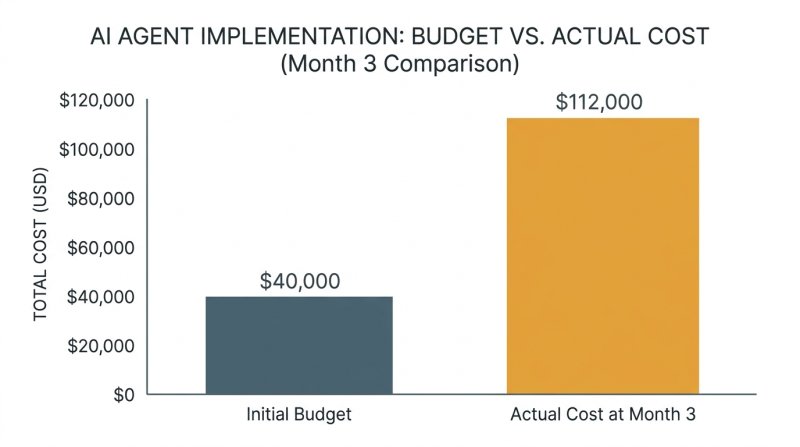
I have watched this happen at a dozen companies now. Not just small businesses either. A manufacturing firm in Dayton -- they made industrial valves, about 220 employees -- budgeted $40,000 for an AI agent implementation and came out at $112,000 by month three. They were not reckless. They just did not know what they did not know.
This is not a post about whether AI agents are worth it. Some are. Some are not. What I want to do is give you the cost anatomy that vendors bury in the appendix, and show you where the actual money goes once you get past the pitch deck.
Per-Agent Pricing Is a Fiction
Most vendors lead with a clean per-agent number. $499 per month per agent. $29 per task. $15 per conversation. You can put it in a spreadsheet and it looks rational and manageable.
Here is what they do not tell you in the initial demo.
Agents do not run in isolation. The moment you start connecting them to your existing systems, you need integration layers. API connectors, authentication handlers, data pipelines. The average enterprise AI agent deployment we have seen involves four to seven supporting services that do not show up as AI agent costs but absolutely show up on the invoice.
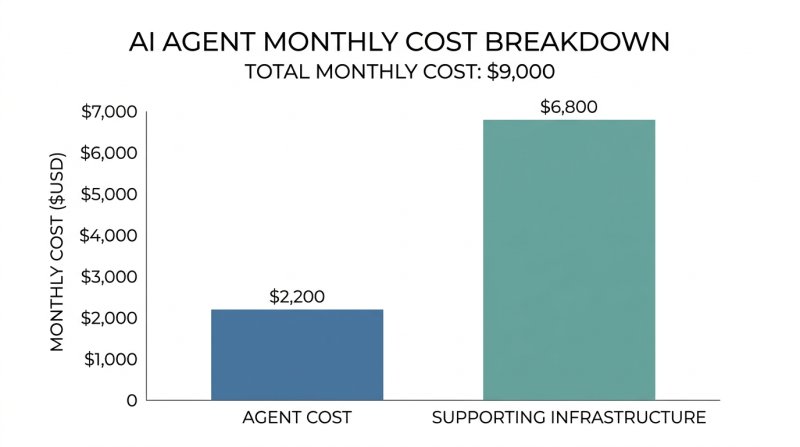
A freight matching operation in Newark was running a single agent for load assignment. The agent cost them $2,200 per month. The supporting infrastructure, data pipelines, and monitoring tools added another $6,800 per month. Nobody told them that part upfront. They found out in month two when the first invoice arrived and did not match the demo.
When you are evaluating AI agent pricing, ask the vendor: what does the fully loaded cost look like once this agent is connected to my CRM, my ERP, and my data warehouse? If they cannot answer that in the first call, that tells you something.
The Four Costs Nobody Puts in the Proposal
There are four cost categories that reliably blindside teams. I call them the four horsemen of the implementation bill.
First, data preparation. Most enterprise data is a mess. AI agents need clean, structured data to function correctly. That means data cleaning, normalization, schema mapping. We typically see this cost at $15,000 to $60,000 before the first agent ever runs a single task. Vendors will tell you they can work with your existing data. Technically true. Practically expensive.
Second, change management. Your team will not use the agent correctly on day one. They will fight it, bypass it, or use it in ways that create more work. That means training, documentation, process redesign. Budget 20 to 30 percent of your total implementation cost for this alone. Most teams skip it. Most teams regret it.
Third, ongoing calibration. Agents are not fire and forget. They drift. The outputs change as your business changes. You need someone monitoring, retraining, and adjusting. This is typically a part-time role, which sounds small until you calculate what part-time expertise in AI systems actually costs.
Fourth, compliance and audit costs. If your AI agent is making decisions that affect customer data or operational outcomes, you need an audit trail. That means logging infrastructure, access controls, compliance documentation. For regulated industries, this alone can add $25,000 to $80,000 to your first year.
Why the Build Versus Buy Calculation Often Goes Wrong
Every team that builds their own AI agent starts with the same spreadsheet. Licensing costs plus internal hours plus infrastructure. They compare it to vendor pricing and the numbers look good on their side.
The problem is that the internal hours line almost always underestimates. It is not the engineers' fault. It is the nature of building something novel. You find problems you did not anticipate. You hit integration challenges that were not in the project plan. The average custom AI agent build we have been involved with takes two and a half times longer than the initial estimate. Which means two and a half times more budget.
One healthcare SaaS company we worked with estimated six months to build an AI agent for patient intake. It took fourteen months. The engineering costs alone came to $340,000. They could have licensed a comparable agent for $180,000 annually. At year three, the build looked worse. At year four, it was not even close. This is not an argument against building -- it is an argument for using honest numbers when you do the math.
What You Actually Pay Per Deployment Type
Let me give you some numbers you can actually use, because vague cost discussions help nobody.
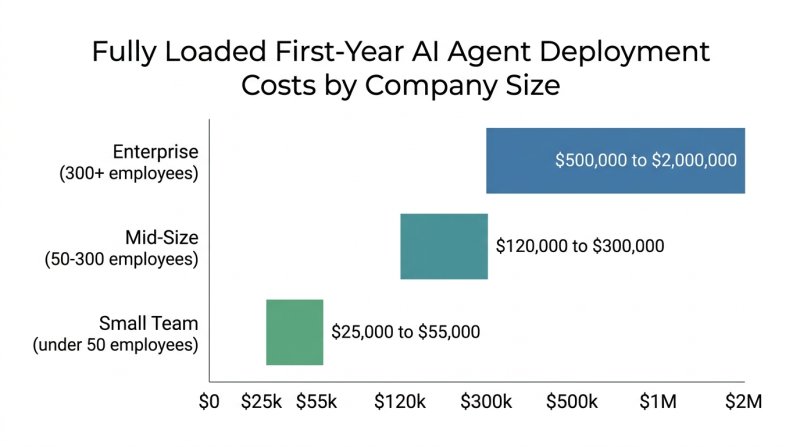
For a small team, typically under 50 employees, running a single AI agent for a specific task like lead qualification or support ticket routing: the realistic fully loaded first-year cost is $25,000 to $55,000. That includes licensing, basic integration, training, and the hidden calibration work in months three through twelve. The vendor might have quoted you $12,000. I am only half joking when I say double the vendor quote and you are still probably close to the real number.
For a mid-size operation, 50 to 300 employees, deploying three to five agents across different functions: realistic first-year cost is $120,000 to $300,000. You are not just paying for agents here. You are paying for the infrastructure to keep them running, the governance framework to keep them aligned with business rules, and the people to manage the edge cases. The edge cases are where it gets expensive.
For an enterprise deployment, 300-plus employees, multiple departments, complex integrations: you should budget $500,000 to $2,000,000 for year one. I know that sounds like a range designed to be useless. But the gap between a simple enterprise agent rollout and a complex one is genuinely that large. The complexity is not in the agents. It is in everything around them. Your existing systems, your data quality, your team's willingness to change how they work.
The vendors who give you a per-agent price and call it a day are not lying to you. They are just showing you the smallest number on the invoice.
The Contract Clauses That Will Surprise You
If you are signing an enterprise AI agent contract, read the following sections before you sign. Every one of them has been the source of an unexpected bill at some point.
Data processing fees. Many vendors charge separately for data that passes through their systems. If your agent handles large volumes of customer records or transaction data, the per-record processing fees can be significant. A retail chain we worked with paid $180,000 in data processing fees in year one on top of their $90,000 agent licensing fee. It was in the contract. They just had not budgeted for it. That one stung.
Rate limits. Most vendors set concurrency limits on agent activity. Exceed them and you either queue, throttle, or pay overage fees. The overage fees are not small. Budget accordingly or negotiate caps with buffer built in.
Minimum commitment clauses. Some vendors require annual commitments with minimum spend. Breaking early means penalties that can exceed the remaining contract value. I have seen this catch founders who expected to scale but could not, and were then locked into a vendor they wanted to leave. The exit penalty was worse than the contract.
Intellectual property clauses. Some AI agent vendors claim ownership of the data your agents process or the workflows they generate. Read this section carefully. In regulated industries, this is not a minor concern. A hospital system we know spent three months negotiating this clause with their vendor. They almost walked away.
How to Budget Honestly for Your First Agent
Here is the framework I give to teams when they ask me how to plan their first AI agent budget. It is not a formula. It is a rough structure that has been right more often than wrong.
Take your vendor quote. Double it. That is your realistic first-year cost, assuming reasonable complexity. If you are above $100,000 in vendor quotes for a first deployment and you have not budgeted at least $200,000 total, you are probably underfunded.
Break the budget into four buckets. Implementation costs, which include data preparation, integration, and training. Licensing and infrastructure, the base cost of running the agent plus the supporting services. Ongoing operations, the people and time needed to keep the agent calibrated and useful. And contingency, which should be at least 20 percent of the total. AI agent projects have a higher variance than most software projects. You need the buffer. The buffer is not optional.
Track the actual cost monthly for the first six months. Not just the vendor invoice. Include internal time. Include the time your team spends managing issues, rewriting outputs, and fighting with the integration. Then compare that number to your projections. If you are consistently over, that is data about whether this deployment makes sense at this scale.
What Happens When You Get the Math Right
I want to be clear about something. AI agents are not a waste of money. Some of the deployments I have seen have delivered genuine ROI. A sales team in Austin cut their proposal generation time from four days to four hours with a single AI agent. A logistics firm reduced their invoice processing errors by 70 percent. These are real outcomes with real dollar values attached.
The problem is not the technology. The problem is that the financial model most teams use to evaluate AI agents does not match how the costs actually arrive. You are not buying a monthly subscription. You are changing how a piece of your business operates. That costs more upfront and delivers more over time, but only if you budget for the full arc of the deployment.
Ask the next vendor you talk to for the fully loaded cost scenario. Not the per-agent price. The scenario. If they will not build it with you, find someone who will.
Frequently Asked Questions
What is the average cost of implementing one AI agent for a small business?
For a small business running a single AI agent for one specific function, the realistic fully loaded first-year cost is typically between $25,000 and $55,000. This includes licensing, basic integration, data preparation if needed, training, and the calibration work that happens in the months after deployment. The vendor quote you receive will often be lower because it does not include these secondary costs. The delta can be significant.
Why do AI agent costs often exceed the initial vendor quote?
Most vendor quotes cover the base licensing or subscription cost. The additional expenses come from data preparation, integration layers, change management and training, ongoing calibration, compliance documentation, and infrastructure to support the agent. These costs are real but are not always disclosed upfront. Asking for a fully loaded cost scenario before signing is the best way to avoid this surprise. It is an uncomfortable conversation but a necessary one.
Is it cheaper to build an AI agent or buy one from a vendor?
It depends on your scale and timeline. For teams under 50 people with a single use case, vendor licensing is usually cheaper in year one and often in year three. For larger organizations with multiple use cases, a custom build can become cost-effective at year three or four. The build versus buy calculation often fails because internal engineering hours are underestimated. The math is situational. The key is using honest estimates on both sides of the comparison, not optimistic ones.
How long does a typical AI agent deployment take to become fully operational?
Most teams underestimate this. A reasonable estimate is three to six months for a simple single-function agent, and six to twelve months for a more complex multi-function deployment. The agent itself might be running in the first week. Getting it to produce outputs that your team actually trusts and uses takes considerably longer. This varies a lot by how resistant your existing processes are to change.
What should I budget for AI agent compliance and audit costs?
In regulated industries or any deployment that handles customer data or makes operational decisions, budget $25,000 to $80,000 for compliance and audit infrastructure in year one. This includes logging systems, access controls, documentation, and potentially third-party compliance reviews. This cost is often missed because it falls outside the agent licensing line item. The exact number depends on how complex your data environment is.
About the Author
Harsumeet Singh is the CEO of UnoiaTech, an AI Automation and SaaS Development agency founded in 2015. With over 150 projects completed and 120-plus clients globally, Harsumeet has spent the past decade helping companies navigate the real economics of AI agent deployments, beyond what the pitch decks show. He has seen the budgets that work and the ones that fall apart, and writes about both with equal candor.